During my employment at Consolidated Metco Inc. in Portland, I met and became friends with a fellow employee named Bob Hogan. I was the thirteenth person hired at this new aluminum foundry in the fall off 1964. Bob had started two or three months earlier. During the next six years we worked in the same office space and for a while our desks were side by side.
Bob was very smart, quite meticulous, deliberate, and sometimes seemed distracted or for some reason unaware of his surroundings. Even though we were quite different we got along.
In about 1966 or 1967 he decided to become a race car owner and driver. To that end he spent about two years building a Formula Ford open-wheel race car from the ground up. He purchased the fiberglass body from a famous manufacturer in Australia and a Ford Cortina four-cylinder engine, a seat, gauges, a steering wheel, racing wheels, and tires. He manufactured the chassis, engine mounts, and front and rear suspension from alloy steel tubing.
After he was finished, he decided to test drive it to make sure all was well. But where? At that time Con Met was only the second plant in the Rivergate Industrial Park and there was about an eighth of a mile of new, straight, smooth road in front of the office. On a nice weekend day, Bob decided to tow the race car to the office parking lot and try it out on the road in front since no one was ever there. He called and asked me if I would help get it off the trailer and then back on when he was finished. Naturally I said yes. I wanted to see if everything worked as planned and be there in case anything unexpected happened.
Everything did work well. He was able to accelerate to a little over 100 mph before he ran out of road. The car was capable of reaching 160 mph but I don’t know if Bob ever drove it that fast. He repeated the test a couple of more times and was pulling into the parking lot when the company president, Ron Burbank, unexpectantly showed up. He didn’t seem too pleased and told Bob not to do that again and furthermore he didn’t want any employee to be driving a race car. Of course, Bob was not happy about that. How dare the company say what he could or could not do on his own time, but we quickly loaded the car on the trailer and left.
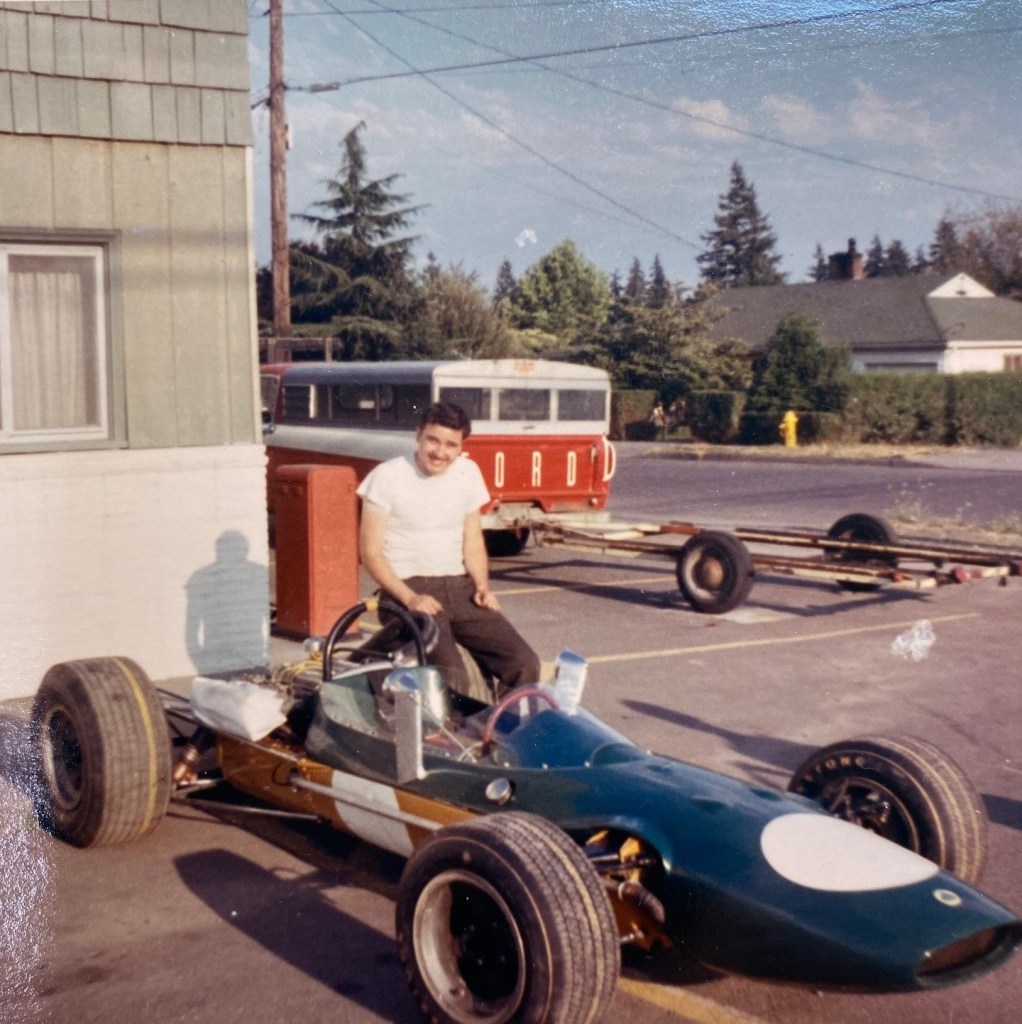
As was Bob’s nature, he wasn’t going to comply with Ron Burbank’s order and as an aggressive statement he wore his driving suit to work on Monday.
Over the next year or so, Bob went to several races. At least one in California and one in Canada, where he drove off the track and into a small stream. When he got home, he had some repair work to do.
The 1969 Rose Cup race in Portland was memorable for me since Bob entered and asked me to be his pit crew. That sounded somewhat important, but it really meant I was to help him get his car off the trailer and back on again after the race. It was fun, however, being in the pits with all the other cars and drivers as well as seeing the race up close.
At these types of road races, several classes of cars are on the track at the same time, so all types of cars enter. Of course, Bob was entered in the Formula Ford class, but higher-powered Formula A cars were also in the race. One A car there was owned by Dick Smothers of the Smothers Brothers fame, although Dick wasn’t there. He didn’t actually drive the car, but rather had a professional driver race it.
Also, before the race a white van towing a closed trailer parked in a pit close to us. When it stopped, the side door opened and three or four very attractive young ladies wearing short shorts, halter tops, and white boots jumped out, opened the trailer back door, rolled a Formula A car out, and got it ready for the race. The driver of the van and the race car was Nick Reynolds, one of the founding members of the Kingston Trio singing group, who had retired to his ranch in Port Orchard, Oregon. As soon as the race was over the ladies loaded the car and their other gear back into the trailer, got into the van, and they drove off.
All in all, it was a fun day.
Sometime later Bob told me about going to another race and a well-known local Porsche racecar driver named Monte Shelton told Bob he wasn’t winning because he was too timid and asked if he could drive his car. Bob consented and Monte finished very high in the race standings, but when he drove the car back to the pits it had tire marks across the nose cone. Apparently, there had been some real racing going on.
Sometime after that Bob retired from race car driving but was hired by Fred Meyer Junior of the food store empire to be his engine mechanic on his limited-production Porsche. For a year or two they went to races all over Canada and the United States. The car and everything they needed was towed in a large trailer to the race site and the driver and crew were flown in a private plane to the race site. Like Dick Smothers, however, Fred Meyer never went to a race while Bob was on the crew.
After I moved to Spokane, I only saw Bob a few times when I traveled to Portland to see my parents. I knew I would always find him and others from the foundry having lunch at the wishing Well Restaurant in St. Johns during the work week.
Bob stayed with the company even after it was purchased by Daimler-Benz. He held several management positions in the quality control department until he retired.
I tried to locate him a few years ago and found he had moved to a small town along the Columbia River west of Portland. When I called his phone number, I got his recorded message that stated something like, “If I don’t know you hang up and don’t call back.” I did leave a message, but never heard from him.
That was Bob Hogan.
 Kenkaiyala.com
Leave a comment