Last evening I watched the fascinating documentary about NASA’s design, implementation, and launch of the two Voyager space crafts in 1977. It is not a reach to say this may have been one of the most important scientific explorations of our universe and now interstellar space.
It was a bold program designed to expand on NASA’s successes in the program to explore our moon. When it was proposed to President Nixon for funding in 1971, he decided if one space craft was good why not send two to double the odds of success.
Looking back at our sending men to the moon and the Voyager program, it has to be remembered the power of the computers used in the spacecrafts was less than that in common use today in everyday cell phones.
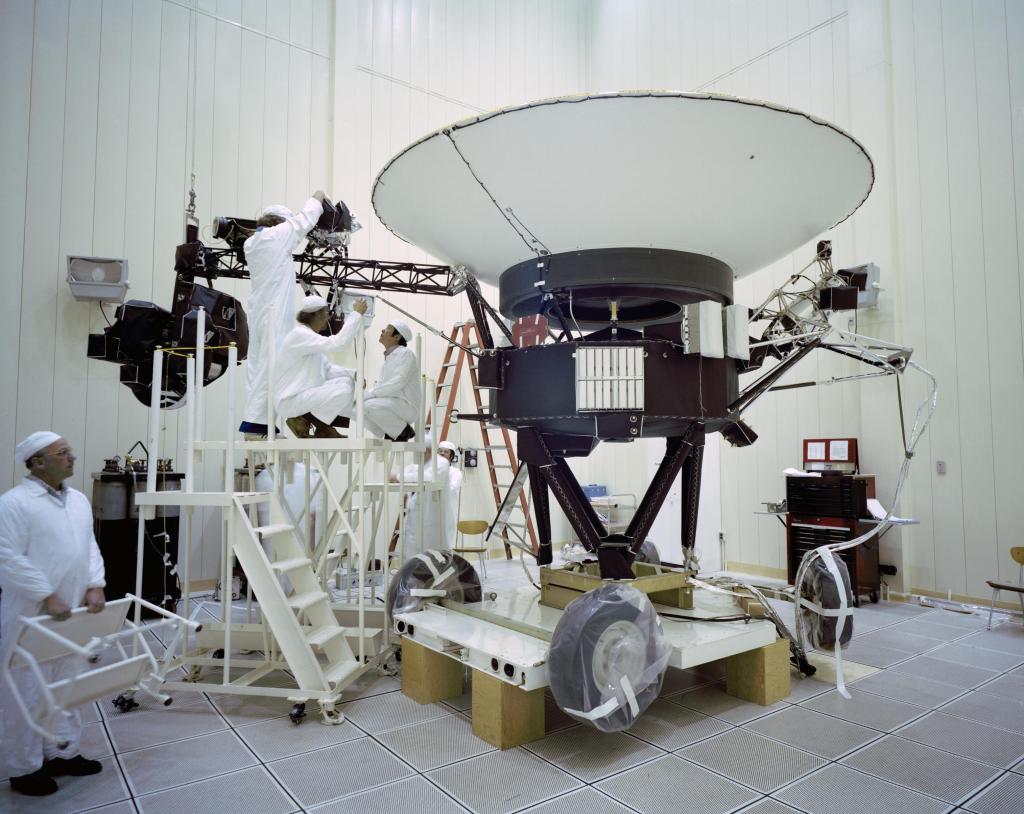
That says volumes about how the brilliance of human vision and collective focused efforts of people, even without the help of today’s technology, can achieve great things.
Using what was then known about our universe through observation through telescopes and mathematical calculations, this remarkable team was able to design a flight that would take advantage of the gravity of each of the four outer planets to “sling shot” the crafts on to the next and then the next and now into the abys of interstellar space. Due to their nuclear power sources that were designed to last a billion years, these crafts are still sending back sensor signals after 40 years. Of course it takes longer and longer for these signal to reach back to earth.
Carl Sagan, a driving force in astronomy and a great communicator at the time, in a stroke of insight, convinced skeptical NASA engineers to turn the spacecrafts’ cameras around and take pictures of Earth before they left our solar system. The resulting photos reveal a tiny bright dot amongst the multitude of stars and planets and show dramatically how insignificant we are in the total scheme of things.
Just in case there is any other intelligent life out there somewhere that may encounter one of these crafts, a gold LP record was placed in each of these crafts saying something about us as well as a diagram showing Earth’s location relative to several important stellar objects. Also on the records are a Beethoven Symphony, “Johnny Be Good” by Chuck Berry, and a diagram showing how to place the arm and stylus onto the record for playback.
Wouldn’t it be great if something actually plays theses records sometime somewhere?
Ken Kaiyala
8-24-17
Update on 10-19-23: Of the 11 instruments on Voyager, four are still sending back data. It has reached interstellar space, but is still in our solar system.
 Kenkaiyala.com
Leave a comment